
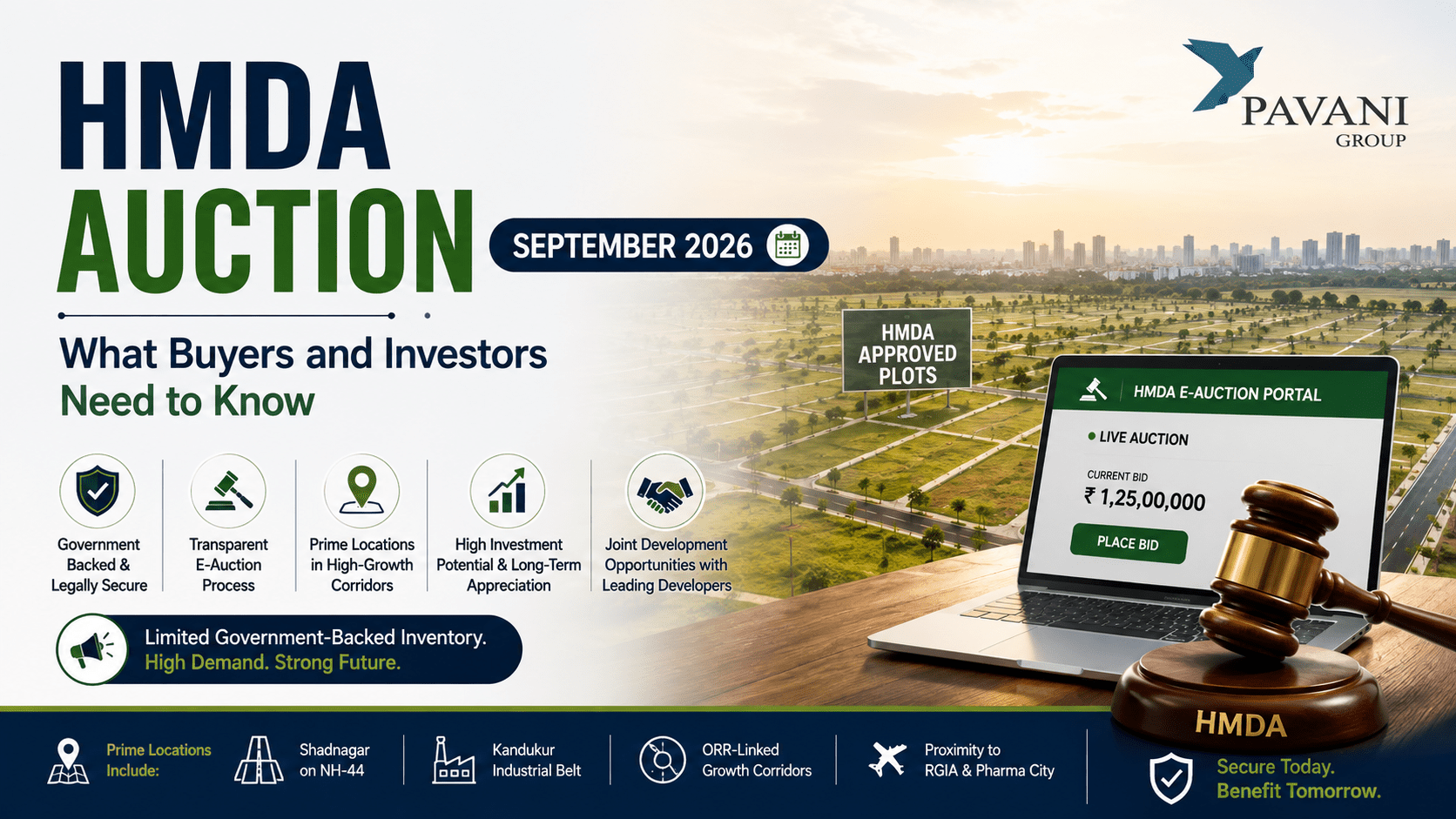
Every few months, the Hyderabad Metropolitan Development Authority (HMDA) opens up fresh land parcels and residential plots to the public through its e-auction process — and the upcoming HMDA auction cycle in September 2026 is generating considerable interest among homebuyers, land investors, and developers alike. If you’ve been tracking Hyderabad’s real estate corridors, particularly the high-growth belts around Shadnagar, Kandukur, and the ORR-linked regions, this auction window deserves your attention.
This guide walks through what HMDA auctions are, how they typically work, what’s driving demand this cycle, and how to prepare if you’re planning to participate.
What Is an HMDA Auction?
HMDA periodically auctions land parcels and developed plots that fall under its direct ownership or that it has acquired and developed as part of planned layouts. Unlike buying from a private developer, an HMDA auction plot comes with the direct backing of a government development authority — meaning the land title, layout approval, and basic infrastructure planning are already handled at the authority level.
These auctions are typically conducted as e-auctions, meaning bidding happens through an online portal rather than in a physical auction hall. This format has made participation more accessible, allowing bidders from across India — including NRIs — to compete for prime plots without needing to be physically present in Hyderabad.
Why the September 2026 Auction Cycle Matters
A few converging factors make this auction window particularly noteworthy:
1. Growth Corridor Momentum Regions like Shadnagar, situated on the Hyderabad–Bengaluru highway (NH-44), have seen a steady uptick in both residential and industrial interest. Infrastructure projects — including road widening, the upcoming Pharma City, and improved airport connectivity — are pushing land values upward across these corridors.
2. Limited Government-Backed Inventory Unlike private layouts, which can expand supply relatively quickly, HMDA auction plots are released in limited, planned batches. This scarcity, combined with rising demand, tends to create competitive bidding, particularly for well-located parcels.
3. Renewed Investor Confidence After a period of cautious activity in some segments of the real estate market, land — particularly government-approved land — has re-emerged as a preferred asset class for investors seeking a hedge against inflation and long-term capital appreciation.
4. Joint Development Projects In some cases, HMDA auction land is developed in partnership with established private developers, combining the legal security of a government auction with the execution capability and amenity planning of an experienced builder. These joint-venture plots often draw particularly strong interest.
How the HMDA E-Auction Process Typically Works
While specific timelines, dates, and terms are announced by HMDA for each auction cycle and should always be confirmed on the official HMDA e-auction portal, the general process follows a consistent structure:
- Notification — HMDA publishes an official notification listing the available plots, their locations, sizes, and reserve prices.
- Pre-Bid Meeting — A pre-bid session (often held online or announced via notification) allows prospective bidders to seek clarifications.
- Document Registration — Interested bidders register on the e-auction portal and submit required KYC documents.
- Earnest Money Deposit (EMD) — Bidders must deposit a specified EMD amount to qualify for participation, which is refundable for unsuccessful bidders.
- Bidding Window — The e-auction opens for a defined period during which registered bidders place competitive bids online.
- Result Declaration — The highest valid bidder for each plot is declared, subject to HMDA’s terms and conditions.
- Payment and Registration — Winning bidders complete the balance payment as per the specified schedule, followed by formal registration of the property.
Because exact dates, EMD amounts, and reserve prices change with every auction cycle — and have occasionally been revised or postponed by HMDA in the past — it’s essential to check the official notification directly rather than relying on secondary sources.
Who Should Consider Participating?
- End-users looking for a plot with clean, government-verified titling to build a home in a growth corridor.
- Long-term investors seeking exposure to land appreciation in emerging Hyderabad suburbs.
- NRIs who want a secure, remotely manageable investment route, given the online bidding format.
- Developers and builders looking to acquire land parcels for future residential or commercial projects.
Key Advantages of Buying Through an HMDA Auction
- Title clarity — Land sold through HMDA auctions generally comes with a clean, authority-verified title, reducing legal risk substantially.
- Transparent pricing — The competitive bidding format means prices reflect genuine market demand rather than negotiated private deals.
- Government backing — Buyers deal directly (or through an authorized process) with a statutory body rather than relying solely on private developer assurances.
- Infrastructure planning — HMDA-auctioned layouts typically follow planned road widths, drainage, and utility provisions as per approved master plans.
Risks and Considerations
No investment is without risk, and HMDA auctions are no exception:
- Competitive pricing — Popular plots can see aggressive bidding, sometimes pushing final prices well above the reserve price.
- EMD forfeiture rules — Bidders who fail to complete payment after winning may forfeit their earnest money deposit, so financial readiness before bidding is essential.
- Infrastructure timelines — Even government-backed layouts can experience delays in road, water, or electrical infrastructure completion.
- Market fluctuation — Like all real estate, land values can be affected by broader economic conditions, so appreciation should be viewed as a reasonable expectation rather than a certainty.
How to Prepare Before the Auction
- Shortlist the specific locations or layouts you’re interested in based on the official notification.
- Complete your KYC and portal registration well in advance to avoid last-minute technical issues.
- Arrange your EMD amount and keep additional funds ready in case you win the bid and need to move quickly on the balance payment.
- Research comparable plot prices in the same corridor to set a realistic maximum bid for yourself.
- Consult a property lawyer to understand the auction terms and conditions thoroughly before bidding.
- If working with a developer partner on a joint HMDA project, clarify what portion of the process they are assisting with versus what you must handle directly with HMDA.
Understanding Reserve Prices and How Bidding Typically Behaves
One of the most common questions from first-time auction participants is how the reserve price relates to the final sale price. In practice, HMDA sets a reserve price based on the plot’s location, size, and prevailing market benchmarks — but this figure represents a floor, not a prediction of the final price.
In high-demand corridors, especially those experiencing active infrastructure development, final bid prices can exceed the reserve price by a meaningful margin, particularly for corner plots, plots facing wider roads, or those closest to highway access points. In less competitive auctions or for less centrally located parcels, final prices may land closer to the reserve.
This is why comparable market research — looking at recent private resale transactions and previous auction results in the same or nearby layouts — is one of the most valuable preparation steps a bidder can take. It helps set a realistic, defensible ceiling for your own bid rather than reacting emotionally in the moment.
The Role of Joint Development Projects in HMDA Auctions
A growing trend in recent HMDA auction cycles involves land parcels tied to joint development arrangements between HMDA and established private developers. In these structures, the land itself carries government-verified approval, while a private developer partner handles layout execution, amenities, and infrastructure buildout.
For buyers, this hybrid model offers a practical middle ground: the legal certainty associated with government land processes, combined with the community planning, amenities, and execution speed that an experienced developer typically brings. Several plots in the Shadnagar and surrounding corridors have followed this pattern, and it’s worth checking whether any plots in the September 2026 cycle fall under a similar joint arrangement, since the buying process and post-auction next steps can differ slightly from a standalone HMDA plot.
What Past Auction Cycles Suggest About Timing
HMDA has, on occasion, revised auction and pre-bid meeting dates for administrative reasons — a pattern seen in several recent cycles across different locations. This isn’t unusual for large-scale government auction processes, but it does mean bidders should build some flexibility into their planning rather than assuming dates are locked in stone until the official notification is finalized.
A practical approach many experienced bidders follow is to complete all preparatory steps — KYC registration, EMD readiness, comparable price research — well ahead of the earliest possible date mentioned in preliminary notifications, so that even if the schedule shifts, they aren’t scrambling to get ready at the last minute.
Tax and Registration Cost Considerations
Beyond the winning bid amount, buyers should budget for additional costs associated with completing an HMDA auction purchase:
- Stamp duty and registration charges, which are set by the Telangana state government and apply to the property’s registered value.
- Legal fees for document verification and registration assistance.
- Any applicable GST or service charges, depending on the nature of the transaction and whether a developer partner is involved.
Factoring these costs into your overall budget before bidding helps avoid a situation where you win a bid but find yourself short on funds for the complete transaction.
Final Thoughts
The September 2026 HMDA auction cycle represents another opportunity to acquire government-backed, title-clean land in some of Hyderabad’s fastest-growing corridors. As with any auction process, success depends on preparation — understanding the notification details, verifying documentation, and bidding within a realistic budget. Given how quickly prime plots can move once bidding opens, buyers who do their homework early tend to be best positioned.
Always refer to HMDA’s official e-auction portal or an authorized project partner for the most current dates, plot listings, and terms, as these details are subject to change.
Frequently Asked Questions
1. What is an HMDA e-auction? It’s an online bidding process through which the Hyderabad Metropolitan Development Authority sells land parcels or developed plots that fall under its ownership, allowing registered bidders to compete transparently for available plots.
2. Who can participate in an HMDA auction? Generally, any individual or entity that completes the required KYC registration and EMD deposit on HMDA’s official e-auction portal can participate, including NRIs, subject to the specific eligibility terms of each auction notification.
3. What is an EMD and why is it required? An Earnest Money Deposit (EMD) is a refundable deposit bidders must pay to qualify for participation in the auction. It demonstrates financial seriousness and is refunded to unsuccessful bidders after the auction concludes.
4. How do I find the exact date and plot details for the September 2026 auction? The most accurate and current information is published on HMDA’s official e-auction portal or notification board. Dates, reserve prices, and plot lists can be revised, so always verify directly before making any financial commitment.
5. What happens if I win a bid but can’t complete the payment? Typically, failure to complete the balance payment within the specified timeline results in forfeiture of the EMD, and the plot may be re-offered to the next eligible bidder or in a future auction cycle. Exact terms vary by notification.
6. Are HMDA auction plots more expensive than privately developed plots? Not always — it depends on location, competition, and reserve pricing. In some cases, auction plots offer better value due to transparent government pricing, while in high-demand locations, competitive bidding can push prices above comparable private listings.
7. Can I get a home loan for an HMDA auction plot? Yes, in most cases. Since HMDA auction plots come with clear government-verified titles, banks are generally more willing to finance them compared to plots with uncertain legal status.
8. Is it possible to participate in the auction remotely, without visiting Hyderabad? Yes, the e-auction format allows bidders to register, submit EMD, and place bids entirely online, making it accessible to NRIs and out-of-state investors, though a personal site visit before bidding is strongly recommended.
9. How is the final auction price determined? The plot goes to the highest valid bid received during the auction window, provided it meets or exceeds the reserve price and complies with HMDA’s bidding terms.
10. What should I do immediately after the auction results are announced? Winning bidders should promptly review the payment schedule, arrange the balance funds, and proceed with registration formalities within the timeline specified in the auction terms to avoid forfeiture of the EMD.