
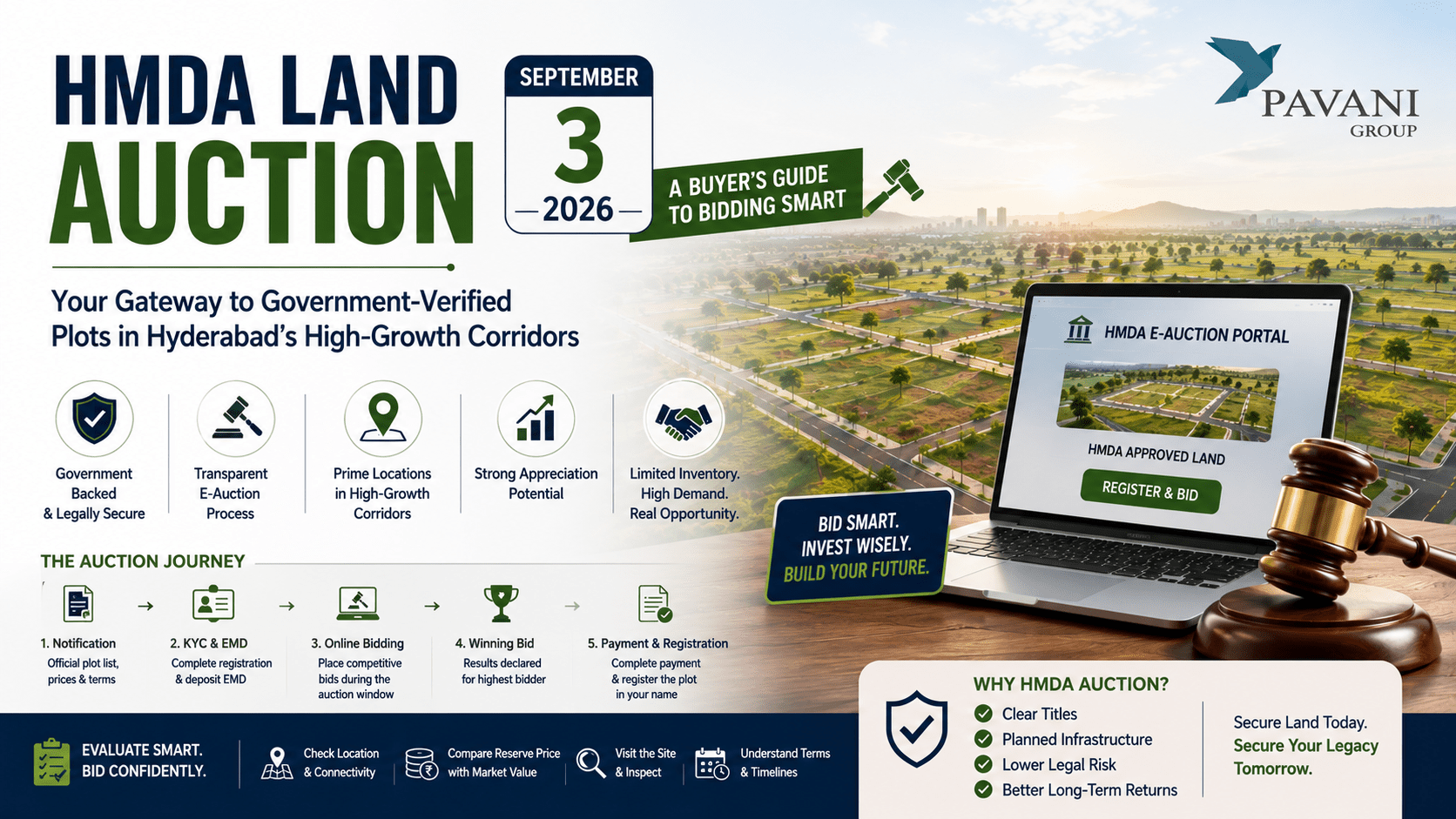
Land auctions conducted by the Hyderabad Metropolitan Development Authority (HMDA) have become one of the most trusted routes to acquiring government-verified plots in and around Hyderabad’s expanding suburbs. With an auction date circulating for September 3, 2026, prospective bidders — from first-time land buyers to seasoned investors — are once again turning their attention to HMDA’s e-auction portal.
This guide breaks down what to expect from an HMDA land auction, how to evaluate whether a particular plot is worth bidding on, and the practical steps to take before, during, and after the auction.
Important note: Auction dates, plot lists, and terms are set and periodically revised by HMDA itself, and have been rescheduled in past cycles for administrative reasons. Always confirm the September 3, 2026 date, along with reserve prices and EMD requirements, on HMDA’s official e-auction portal before making any financial commitment.
Understanding the HMDA Land Auction Format
HMDA land auctions differ from typical developer plot sales in one crucial way: the land being sold is either owned directly by HMDA or has gone through HMDA’s planning and approval process, which means the fundamental legal and infrastructure groundwork is already in place. Bidders aren’t buying “on faith” from a private seller — they’re bidding for land that has already cleared a government authority’s due diligence.
The process is conducted online through HMDA’s e-auction system, which typically involves:
- Publication of an official auction notification listing plot numbers, locations, dimensions, and reserve prices
- A pre-bid clarification window for prospective participants
- Online KYC registration and EMD payment to qualify as an eligible bidder
- A defined bidding window during which competitive online bids are placed
- Declaration of results, followed by payment and registration formalities for winning bidders
Why This Auction Cycle Is Drawing Attention
Several factors are converging to make the September auction cycle particularly competitive:
Growth Corridor Positioning Many of the plots released in recent HMDA auction cycles fall within or near high-growth corridors such as Shadnagar, Kandukur, and areas along the Hyderabad–Bengaluru highway. These regions benefit from improving road infrastructure, proximity to the Rajiv Gandhi International Airport, and upcoming industrial developments like Pharma City.
Scarcity of Government-Backed Land Because HMDA releases auction plots in limited, planned batches rather than continuously, each cycle tends to attract a concentrated pool of serious bidders, which can drive prices above the reserve price for well-located parcels.
Rising Preference for Verified Titles With increasing awareness around land title disputes in the private resale market, more buyers are actively seeking government-auctioned land specifically because of the reduced legal risk.
How to Evaluate a Plot Before Bidding
Not every plot listed in an auction notification will be an equally strong opportunity. Before placing a bid, consider:
- Location relative to major roads and highways — Proximity to NH-44, ORR access points, and planned infrastructure projects tends to correlate strongly with long-term appreciation.
- Plot dimensions and shape — Corner plots and those facing wider roads typically command premium resale value.
- Surrounding development — Established or rapidly developing residential layouts nearby are usually a positive signal.
- Reserve price versus comparable market rates — Research recent transaction prices for similar plots in the same micro-market to judge whether the reserve price represents fair value.
- Physical site visit — Auction listings can look appealing on paper; a physical visit helps confirm access roads, terrain, and immediate surroundings.
Step-by-Step: Preparing to Bid on September 3, 2026
- Track the official notification — Confirm the exact date, plot list, and terms directly through HMDA’s e-auction portal, since these details can be updated closer to the auction.
- Complete KYC registration early — Portal registration and document verification can take time; don’t leave this until the last day.
- Arrange EMD funds — The Earnest Money Deposit is a prerequisite for participation and is typically refundable if you’re unsuccessful.
- Set a maximum bid limit — Decide your ceiling price in advance based on comparable market research, and stick to it to avoid emotional overbidding.
- Keep balance payment funds ready — If you win, you’ll need to complete the remaining payment within a specified window, so have financing arranged beforehand.
- Consult a property lawyer — Have the auction terms and conditions reviewed so you fully understand payment timelines, forfeiture clauses, and registration procedures.
What Happens After You Win a Bid
Winning an HMDA land auction bid is just the first step. Typically, the process continues with:
- Confirmation of the winning bid and issuance of a formal letter or intimation from HMDA
- Balance payment of the remaining plot value within the timeline specified in the auction terms
- Registration of the sale deed in the buyer’s name, following standard property registration procedures
- Handover of documentation, including the layout approval details and any relevant infrastructure commitments
Failure to complete payment within the stipulated timeframe generally results in forfeiture of the EMD and reallocation of the plot, so financial preparedness before bidding is critical.
Common Mistakes to Avoid
- Bidding without a site visit — Photos and listings don’t always convey terrain issues, nearby developments, or access road realities.
- Ignoring the fine print — Auction terms often include specific timelines and penalty clauses that are easy to overlook in the excitement of bidding.
- Overbidding under competitive pressure — It’s easy to get caught up in a bidding war; sticking to a predetermined ceiling protects your investment logic.
- Delaying KYC and EMD arrangements — Technical or documentation delays can disqualify you from participating even if you intended to bid.
Reading an HMDA Auction Notification Correctly
Auction notifications can look dense at first glance, but they typically follow a consistent structure worth understanding before you bid:
- Plot schedule — A table listing individual plot numbers, dimensions, facing direction, and reserve price.
- Eligibility criteria — Who can participate, and any restrictions that may apply to specific categories of bidders.
- EMD and bid increment rules — The minimum deposit required and the minimum amount by which each new bid must exceed the previous one.
- Payment schedule — The exact timeline for balance payment after a winning bid is declared, along with any penalty clauses for delayed payment.
- Terms and conditions — Legal clauses covering possession, registration responsibilities, and dispute resolution procedures.
Reading through the full notification carefully — not just the headline plot list — is one of the most overlooked steps by first-time bidders, and it’s often where important details about timelines and obligations are found.
Comparing This Auction to Private Resale Alternatives
For buyers weighing whether to pursue an HMDA auction plot versus a private resale plot in the same general area, a few distinctions are worth keeping in mind:
Title Certainty Auction plots carry the direct backing of HMDA’s ownership or approval process, generally offering stronger title certainty than private resale land, where verifying the complete chain of ownership can be more time-consuming and occasionally uncertain.
Price Transparency Auction prices are determined through open, competitive bidding, which tends to reflect genuine market demand at that moment. Private resale prices, by contrast, are negotiated individually and can vary more based on the seller’s urgency or the buyer’s negotiating position.
Timeline and Process Private resale transactions can sometimes move faster since they don’t involve a structured bidding window, while auction purchases follow a more formal, staged timeline dictated by HMDA’s process.
Availability Auction plots are released in limited batches tied to specific cycles, while private resale inventory is available more continuously, though with varying levels of legal clarity.
Neither route is universally “better” — the right choice depends on how much you value title certainty and transparent pricing versus transaction speed and flexibility.
Financing Your Auction Purchase
If you plan to finance your plot purchase through a bank loan, it’s worth starting conversations with lenders before the auction date, not after. Key points to discuss with your bank or financial institution include:
- Whether they finance HMDA auction land specifically, and what documentation they require
- Expected loan-to-value ratio for plot purchases (typically lower than for constructed properties)
- Processing timelines, since you’ll need funds available quickly after a successful bid
- Interest rates and any special schemes applicable to land purchases in government-auctioned layouts
Having a pre-approved or in-principle loan sanction in hand before bidding can significantly reduce the stress of meeting payment deadlines after winning a bid.
Final Thoughts
An HMDA land auction offers a rare combination of government-verified legal security and competitive, transparent pricing — a combination that’s increasingly attractive in a real estate market where title disputes remain a genuine concern for private resale purchases. If the September 3, 2026 auction cycle includes plots in growth corridors you’re tracking, doing your homework early — on documentation, comparable pricing, and your own budget ceiling — will put you in the strongest position to bid confidently.
As always, treat the specific date, plot inventory, and terms mentioned here as a starting point for your research, and confirm every detail directly through HMDA’s official channels before proceeding.
Frequently Asked Questions
1. Is the HMDA land auction on September 3, 2026 confirmed? Auction dates are set and published officially by HMDA and can be revised or postponed for administrative reasons, as has happened in past cycles. Always verify the current status directly on HMDA’s official e-auction portal before making any plans or payments.
2. What documents do I need to participate in the auction? Typically, participants need standard KYC documents (identity proof, address proof, PAN details), along with completed online registration and EMD payment confirmation on the HMDA e-auction portal. Exact requirements are listed in each auction notification.
3. What is the minimum amount I need to bid? Each plot has a reserve price set by HMDA, below which bids will not be accepted. The reserve price and any bid increment rules are specified in the official notification for that auction cycle.
4. Can I inspect the plot before the auction date? Yes, and it’s strongly recommended. Site visits help you verify the plot’s actual condition, access roads, and surroundings before committing to a bid.
5. What happens if multiple bidders place the same highest bid? HMDA’s auction terms typically include tie-breaking procedures, such as a follow-up bidding round among tied bidders. Specific rules are detailed in the official auction notification.
6. How soon after winning do I need to pay the balance amount? Payment timelines are specified in the auction terms and vary by cycle, but delays beyond the stipulated window generally risk forfeiture of the EMD. Confirm exact deadlines in the official notification.
7. Are HMDA auction plots suitable for immediate construction? Many auctioned plots are part of developed layouts with basic infrastructure in place, but it’s important to confirm the specific infrastructure status of your plot, including road, water, and electrical connections, before planning construction.
8. Can NRIs participate in the HMDA land auction? Generally yes, since the e-auction format allows remote registration and bidding, though NRIs should confirm any additional documentation requirements that may apply to their specific situation.
9. Is financing available for HMDA auction land purchases? Banks are typically more willing to finance HMDA-auctioned plots due to their clear government-verified titles, though loan approval still depends on the specific plot, lender policies, and your financial profile.
10. Where can I get updates closer to the auction date? The most reliable source is HMDA’s official e-auction portal and notifications. Authorized project partners or developers involved in a specific layout may also share updates, but always cross-verify against HMDA’s official communication.